Wednesday, August 31, 2011

What Will People Make When Anyone Can Make Anything?

Today's guest blog is by Scott Harmon, Z Corporation VP of Business Development

You can feel it coming. It has been coming for a while now. Slowly at first. Gathering momentum of late. The power to create.

Once solely the domain of engineers and industrial designers, the power to create is increasingly moving into the hands of everyone else.

The first wave has been driven by the increasing popularity of services like Shapeways and i.materialise, easy to use, fairly priced service bureaus that cater to the creative class. They have leveraged Web 2.0 to create an experience that is part Facebook and part Etsy. Fun to share your creative work, easy to profit as well.

We’ve also seen a lot of interest in ‘The Clones’, that is, the dizzying array of FDM knock-offs whose low price point has captured a great deal of attention. While real numbers are hard to come by, 'The Clones' have strong appeal among the maker class, and have driven 3D printing into a new market.

However, both of these developments are still hampered by the critical bottleneck. Most people can’t make a 3D file. Without mass access to a 3D file creation, there will be no mass market for 3D printing. Bigger markets, to be sure, but not mass markets. The good news is that it’s coming. The technology exists. The websites are being created. The sales channels are developing.

Pretty soon, anyone from your 8 year old son to your 70 year old mother will have the power to create. No training. No cost. No software required. It will be as easy as playing a video game, and less expensive.

That’s a given. The really interesting question is: what will they make? Will they make replacement parts for tools? Will they make art? Will they copy things that already exist?

What would you make if you could make anything on a 3D printer?

http://www.zcorp.com/

Wednesday, August 24, 2011

Multicolor 3D Printing: Fact vs. Fiction

Today’s guest post is from Joe Titlow, VP of Product Management at Z Corporation.

Z Corporation invented color 3D printing over 10 years ago and continues to be the only 3D printer manufacturer to offer true color 3D printing. Interestingly though, some other printers on the market have begun to talk about their ‘color capabilities’ as well. And while we appreciate the reinforcement that being able to 3D print in color is valuable and important, it occurred to me that people might not understand the technical differences between the various 3D printing technologies with regard to color capabilities. So to better educate everyone, I thought I would outline the technical differences and then the color-related applications are appropriate for the various technologies.

 Most 3D printing and rapid prototyping technologies (SLA, SLS, DLP, etc.) work in ‘monochrome,’ where only one color is used and that color is the base color of the material.  There are a few technologies that claim ‘color’ 3D printing, but the definition of what it means to print in ‘color’ differs wildly between vendors.  As far as I know, there are three companies that claim to offer color 3D printing:

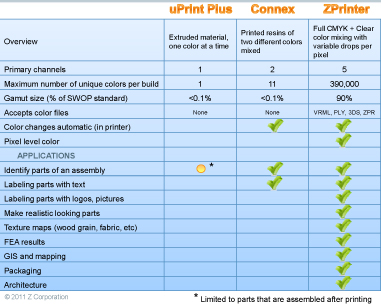
- Stratasys/uPrint (HP in Europe):  the uPrint Plus is marketed as a 'color 3D printer' because it can produce color parts in eight different colors.  However, this can only be accomplished one color at a time, as switching between one color and another requires the operator to manually switch the printer’s input plastic reel.  The only way these printers can produce 'multicolor' parts is if the operator manually assembles the separate monochrome parts after they are printed.  This is similar to printing individual pieces of paper on a document printer, each with one color, and then gluing them together afterward to form a multicolor picture.  It’s laborious, time consuming, and the colors produced are very limited.

- Objet Connex 3D Printers: The Connex printers from Objet, as a byproduct of their ability to print different resins at the same time, are able to produce a handful of colors.  The maximum number of unique colors available in one build is 11 (all shades of gray) and this is accomplished by mixing a white resin and a black resin for large sections of a part.  These printers cannot address pixel-level color variation - only 'shells' of model (or large sections of the design).   They also cannot accept color files into their software – the colors (or really the materials) are assigned manually during the process by the operator. 

- Z Corporation has a range of multicolor-capable 3D printers, ZPrinters, that produce color by mixing the fundamental primary colors of Cyan, Magenta, Yellow, Black and White together.  This is done on the fly, automatically during printing and results in 390,000 unique color combinations. This enables true color printing in any color that the customer desires.  Since ZPrinters  create these unique colors at the pixel level, detailed texture maps can be used to simulate the appearance of various materials, add logos, and basically build any image into a prototype that might be desired.  The result here is some incredibly life-like models that other 3D printing technology simply can’t produce: 


The following chart highlights these technical differences and indicates which color applications are feasible among the three different 3D printing technologies:

Wednesday, August 17, 2011

Creativity and Constraints

This week's guest blog is from Scott Harmon, Z Corp VP of Business Development.

Creativity and Constraints.

These two go together like oil and water, or here in Boston, Yankees and Red Sox. They are the great paradox of design and engineering. Constantly at war with each other. Battling for supremacy. When constraints win out, products are dull and uninspiring. They are dead before they reach the shelf. When creativity wins out, products are novel and catch the notice of customers, but budgets are wrecked, timelines are blown and no one seems to notice.


Inside this conflict is where innovation lives. Innovation is when companies deliver products that exceed customer expectations, and do it on time and under budget. Failure on either attribute is still failure.

So the question is, how do you wrestle these two beasts to the ground? How do you deliver a product your customer wants, and do it faster and less expensively than ever before? It shouldn’t come as a big shock that a 3D printer company would say “prototype more,” and we do. But the new frontier of prototyping is less about getting to market faster with less cost, and more about creativity. How do you make sure that the product that you are delivering is the product your customer wants?

The answer is obvious, but relatively few companies actually do it. How about showing your customer the product long before it’s a product? How about creating with them?

When I was a product manager, I was always frustrated by how we showed new product ideas to consumers. We would brainstorm some ideas and have an artist draw them up on a sheet of paper. The images would have explanations for various features and such. Then we would show it to groups of consumers and discuss it. I’m sure you have all been there. It was maddening. You’d get really helpful feedback like “That’s not possible.” or “Would it come in yellow?” The boss was not happy to see the bill for a focus group with those kinds of results.

These days you can put a physical prototype in front of the focus group for less than the cost of the focus group. You can get a real response from your customers about what works for them and what does not from a prototype with the color and feel of an actual product. If you want to make sure you customers love your products, give them the product long before it is actually a product.

http://www.zcorp.com

Wednesday, August 10, 2011

Create more…innovation: WWI Soldier, Killed in Action, Finally Identified with Help of 3D Printing

In his blog on July 20th, Z Corp. CEO, John Kawola outlined Z Corp.'s "Create more" vision for continuous innovation. Our next few blogs, by Julie Reece, highlighted real examples of our how customers are creating more with 3D printing.

Soldiers who’ve gone missing in battle are often forgotten, but not by their loved ones, who agonize over the mystery. That’s why the recent identification of a First World War soldier killed in action still matters, even though he died nearly a century ago.

CHALLENGE: Identifying the Remains
Two sets of remains were found years ago at a construction site near Avion, France. The first soldier was identified four years later using DNA analysis. Because of difficulty tracking down living relatives for numerous potential matches, DNA was of no use for the second set.

Initially stymied, investigators enlisted a novel combination of identification disciplines, including Z Corporation 3D printing technology, to confirm the identity of the remains and achieve some closure for the family.

STRATEGY: 3D Printing, Facial Reconstruction
The identification team had several large skull fragments of the unidentified soldier. They performed CT scans on the fragments and assembled the data into 3D computer models using Amira and 3ds Max computer-aided design software. To narrow the list of possible matches for the remains, they constructed physical models of the skull using a Z Corporation 3D printer.

Using muscle markings on the 3D printed skull model, scientific tissue-depth tables, and plastilina modeling clay, the team worked with noted artist Christian Corbet to construct a rudimentary face on the model. They photographed that face and superimposed images of it onto existing photographs of soldiers who were potential matches. By assessing how the images lined up – by face height, width and features such as jaw shape — the team was able to narrow the list of potential matches to two. An isotopic analysis of teeth and the jaw bone indicated that the recovered soldier grew up in Dublin — a direct biographical match with a soldier in one of the matching photographs — Private Thomas Lawless.


RESULTS: Positive ID
The announcement came from the Canadian Department of National Defence. Private Thomas Lawless, born April 11, 1889, was a member of the 49th Battalion, Canadian Expeditionary Force. He was killed in action on June 8, 1917, a few months after the Battle of Vimy Ridge. He was 28.

His remains were recently buried at La Chaudière Military Cemetery in Vimy, France, with his family in attendance. La Chaudière, a Commonwealth War Graves Commission cemetery, currently has 907 servicemen from the First World War buried or commemorated there, including Private Herbert Peterson, the soldier whose remains were found with Private Lawless.

“Anthropological analysis and mitochondrial DNA testing are standard approaches for identification,” explains Andrew J. Nelson, a key researcher on the project and associate dean of research for the faculty of social science at the University of Western Ontario. “However, mtDNA requires material from living family members on the maternal side to make a connection. In this case, we had none of that at our disposal. To the best of my knowledge, this is the first instance in which facial reconstruction and isotopic analysis were added to the mix. It may result in a new protocol, or certainly new tools, for the identification of the missing.”

More Applications for 3D Printing
Nelson sees a variety of applications for 3D printing in anthropology beyond the identification of soldiers’ remains. For example, his team used Z Corporation 3D printing in the facial reconstruction of an Egyptian mummy housed at the Chatham-Kent Museum in Chatham, Ontario. But that’s just scratching the surface, he says.

“Societies who wish to move forward must know their past to better understand who they are now and where they might be going,” he said. “The high variability of cultures of the past – before the internetworking of the world — tells us a lot about the interplay of traits like gender, status, health and wealth in different settings. It’s the bones that help us associate those cultural traits with a particular set of human remains.

And though CT scans enable us to look inside a mummy, for example, without disturbing the bones, wrappings and so on, 3D printing lets us extract these pieces, figuratively speaking, by creating a physical model from CT scan data. We can thus examine the bones more closely and learn more from them.”

For the descendants of Private Lawless, these investigation methods accomplished something more personal. As Nelson says, “Although it’s sad to contemplate the loss of young lives in war, it’s rewarding to account for the missing, both for the sake of the deceased and for long-grieving family members.”

http://www.zcorp.com
 
Be sure to check out the viral 3D printing YouTube video!

Wednesday, August 3, 2011

Create more…communication: Denby Pottery Extracts Unanticipated Benefits from 3D Printing

In his blog on July 20th, Z Corp. CEO, John Kawola outlined Z Corp.'s "Create more" vision for continuous innovation. Our next few blogs, by Julie Reece, will highlight real examples of our how customers are creating more with 3D printing.

Every so often, the return on a business investment exceeds expectations.

Among the lucky few is The Denby Pottery Company Ltd., the venerable United Kingdom tableware manufacturer. The company invested in a 3D printer intending simply to prototype its design concepts on an “occasional” basis, but has found the machine surprisingly useful for time- and money-saving applications in marketing, manufacturing and stoneware casting.

The 600- employee company annually produces more than five million pieces of tableware, coveted by newlyweds, discriminating hosts and connoisseurs around the world.


Challenge: Time-Consuming Prototypes
Before any product is sold, Denby creates several prototypes for internal review. For the better part of two centuries, the company’s designers hand-turned and hand-carved new design concepts in plaster. Despite the prodigious skills of the carvers, some having more than 25 years of experience, the process was time-consuming and never produced 100-percent accurate models. As a result, it was hard for clients to fully understand the concept being proposed. Additionally, the fact that a prototype could take as long as four weeks to create made the company perhaps too careful about introducing new products.


Denby Pottery needed a way to reduce the time it took to produce a physical concept prototype, increase the accuracy and quality of those prototypes, and put designers back into the design studio where they could focus on generating new ideas.

The designers investigated various rapid prototyping systems, eventually requesting a demonstration of 3D printing technology from Z Corporation.

Solution: 3D Printing
Denby was quickly convinced that Z Corporation’s technology could save time, improve model accuracy and free designers to concentrate on designing new and better products. Just to make sure, Denby performed a cost comparison against contracting with a service bureau for prototypes. The analysis revealed that the service bureau’s cost for a typical model would be twice that of printing models in-house. Denby estimated a Z Corporation 3D printer would pay for itself in four years, in part because of its low operating costs: its printing materials, for example, cost one-tenth to one-third that of competitors.

Denby purchased a ZPrinter® 3D printer, the fastest 3D printer on the market, five to 10 times faster than other companies’ technologies. Initial expectations were high, but realistic.

Results: Time and Money Saved, Product Lines More Profitable
As expected, the printer has dramatically reduced Denby’s prototyping work. A concept model now takes two hours to print versus up to four weeks to hand carve. Designers now have the time they need to work in the studio and focus on new designs. They quickly and easily produce clear visual samples they can present to company directors, and it’s easy to duplicate samples for additional audiences.

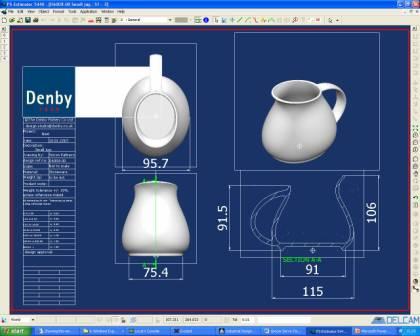
Designers create prototypes in their DeskArtes 3D computer-aided design software, then transfer designs to the ZPrinter. “We then hit print and go make a cup of tea,” says Designer Gary Hawley. “It would take 10 full-time carvers to keep up with the machine.”


The printer cranks prototypes out all week and throughout the weekend, far busier than anticipated. In The company purchased a second Z Corporation printer, adding full 24-bit multicolor capability and a large build area. “Anything Denby Pottery makes, from the smallest espresso cup to the largest casserole, it can print,” says Hawley.


Unexpectedly, the company is saving time and money through its use of 3D printed prototypes in marketing and manufacturing. Marketers use 3D printed prototypes in customer focus groups, enabling the company to obtain high levels of broad-based customer feedback prior to committing to a new product line. “Customers enjoy handling the prototypes and usually think they’re real,” says Hawley. “We gently explain that they’re not for sale quite yet.”

Since tiny variations in designs can make the difference between a bestseller and a failed line, Denby often revises designs during focus group sessions based on customer requests. “3D printed prototypes in our focus groups give the company new levels of confidence in our product lines and benchmark data for our business decisions,” says Hawley. “We’re now confidently backing the winners rather than rolling the dice.”

3D printing also allows Denby to freely share designs with large retailers that carry its product lines. In addition to the hard and fast design communication benefits, 3D printing impresses customers when they tour Denby’s offices. Seeing the device print accurate models reinforces the Denby brand as one that leverages the best technology and makes the most forward-looking business decisions.

3D printed prototypes have also reduced Denby’s manufacturing costs. As new designs approach final approval, designers and manufacturers meet to examine prototypes and identify any potential problems in manufacturing the designs as intended. The team now eliminates in one day problems that previously took three to four weeks to reveal themselves as costly downstream mistakes.

The accuracy of 3D printed prototypes saves additional time and money by enabling Denby to make molds for casting from properly scaled printed models instead of specially handcrafted mold patterns. As a result, production prototypes can now be cast and glazed in two weeks instead of six.

3D printing has streamlined partner interactions as well. Denby works with partners in Thailand who manufacture its china products and partners in Portugal who manufacture its porcelain products. Prior to obtaining 3D printing capabilities, Denby sent these partners flat, 2D technical drawings, which were easy to misconstrue. Denby now sends 3D digital files and 3D printed samples, eliminating mistakes and saving time and money. Costa Verde Porcelains, a partner in Portugal, has even purchased its own ZPrinter to better serve Denby and other customers.

“Many investments yield surprises, but our investment in Z Corporation’s 3D printing technology has yielded most pleasant ones,” says Hawley. “We’ve found a host of unanticipated applications for 3D printing and myriad unanticipated benefits. The result is dramatic time savings and more successful product launches. In fact, we have shortened product launch time from four to two years, concept to availability. Much of that reduction is attributable to 3D printing and associated benefits.”

http://www.zcorp.com

Check out the viral 3D printing YouTube video!

Wednesday, July 27, 2011

Create More...Ideas: Kamen Rider CRD Buckle

In his blog posting last week, Z Corp. CEO John Kawola outlined Z Corp.'s "Create more" vision for continuous innovation. Our next few blogs will feature real customers who are creating more with 3D printing.  Today's guest blog is from Russ Ogi, Chief Operating Office at Z Corp. partner, Rapid Technology, LLC., and is the next in a series of blogs he is writing about his design and creation of a Kamen Rider Suit.

In the myth of the fictional Kamen Rider universe, belts and belt buckles have been an integral part of the character. Possibly because that area of the human body is believed to be the center of Chi energy. Chi is a concept held by many Asian cultures as a universal energy that people can channel for health and vitality.

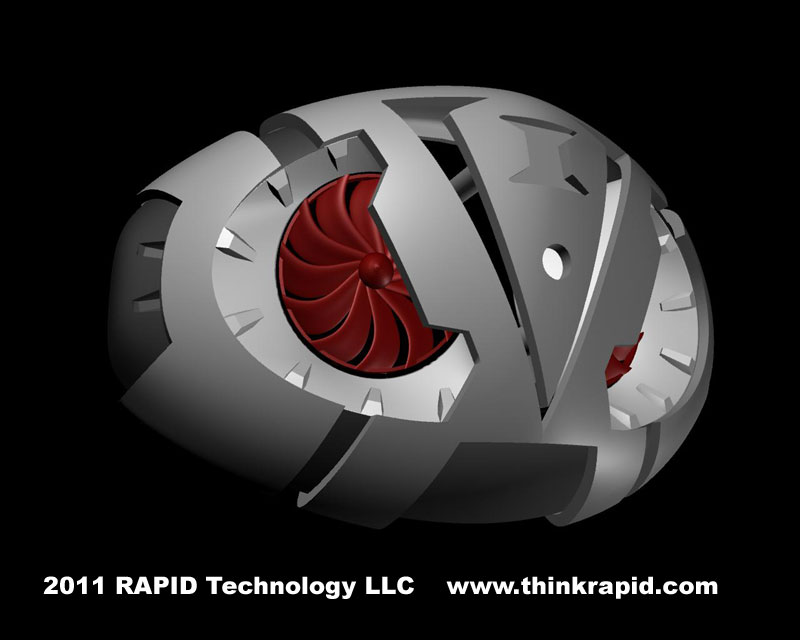
For Kamen Rider V3, the belt called Double Typhoon, would use the twin turbines to draw in wind energy and allow him to change from his human form to superhero form.

The Double Typhoon design (see photo below) from the 70's TV show is a classic and is as iconic to fans as the helmet is. We wanted to keep the concept and feel of the original but make it more contemporary. Being a huge fan of the Kamen Rider V3 series, I wanted to pay homage to the original and was careful with what liberties we took with the design elements.


I worked with Calvin Lac, an Application Engineer here at RAPID Technology, on the design (see photo below). The drawing is also done by Calvin. We started the design process by looking at different versions of Kamen Rider V3 action figures and fan art. We tried as best as we could to come up with a unique version of the classic. From there, we examined the look and feel of the piece. We wanted the buckle to be aggressive and have some heft to it.


We developed the idea of setting the turbines back from the surface the way fighter jet engines are. This gave the buckle more depth and allowed us to be more creative with the shape of the openings for the turbines. The partially hidden turbines give the model visual interest and causes the viewer to move around the piece to take it all in.

Calvin did extensive research on fighter jet intake shapes and eventually settled on a configuration like the Harrier Jet. We spent a good deal of time balancing how visible the turbines should be. I wanted to keep the turbines a prominent part of the visual composition like the original, whereas Calvin took a practical approach to keeping the fans protected and hidden, like an actual fighter jet.

Once we had the main layout, we focused on the details. Since the intake wells were much more visible then that of a jet, they needed accents and Calvin actually drew inspiration for the buckle's intake "teeth" from a watch face he saw. He also suggested the idea of changing the number 3 to the Roman Numeral III. I thought it was a great interpretation and one that I had never seen before on any iteration of the character.

Calvin crammed all these ideas, brilliantly, into one drawing. Now it was my turn to transform a 2D sketch into a mythological personal power plant. This is the final design of the model I created in Maya.

From there, we began fine tuning the design. The model went through a couple of iterations.

Looking at the physical models, we were able to pick out two elements that needed to be changed.

Since the buckle wasn't curved enough to conform to the human body and the turbines did not stand out enough, we went back to the 3D model and made some adjustments. With their speed and low cost, the ZPrinters were the ideal tool for troubleshooting the design and within a few hours time we had the new version.

Here we have the raw prints.

The buckle itself was printed in separate sections but here we placed the parts together for visualization and for fun. The battery is shown for scale.

This next image is a work in progress.

The parts are then separated into individual pieces. You can see the early stages of the prep work for painting. The center section has already been sanded and primed and the inlets have just had the filler putty added.

In this next image we see the buckle together again with the parts all painted just prior to assembly.


Next, we focused on the internal components.

The fans are rigged with small motors that you can see to the upper left of the main buckle housing. The turbines in the picture were test printed on the ZPrinter again, to trouble shoot the design and fit of the turbines.

In this picture, you can see the evolution of the turbine.

Subtle, yet important changes. The turbine in the upper right is the original with a flat center. That was followed by the one on the lower left. The center was changed to a cone initially for aesthetics. The final turbine design has a deeper cone to house part of the turbine motor. In the end, the turbine was created on the ZBuilder for its extra-high resolution on delicate parts.

I had expected the turbines to undergo design iterations but the funny part is that I thought the fine tuning would be to the blades and their angles, not the cone. Turns out, we got the blades right the first time out. The "III" emblem was also created in the ZBuilder, again for the fine detail.

Here we have the final buckle assembled.

A sheet of transparent colored plastic is placed over the center "V" design for eventual back lighting. An LED is used in the central dot below the "III" emblem.

Just for effect, we took a shot of the buckle with the CRD helmet.

As a long time fan of the original character, it was cool to see these two models together.

See more examples of how people are "Creating more" with 3D printing:
http://www.zcorp.com/en/Company/Customers/Case-Studies/spage.aspx
and
http://www.zcorp.com/en/forward/events.aspx?c=15

See the now famous viral 3D printing YouTube video

Wednesday, July 20, 2011

Create more. Z Corporation's Vision for Continuous Innovation

Today's guest blog is from John Kawola, CEO, Z Corporation.

Some people punch the clock. Others live to make a mark.

If you get out of bed in the morning to push the boundaries of the possible, Z Corporation can help you get there. We exist because you are an inspired designer or engineer who wants to create more. More ideas, more communication and more innovation.

We believe that invention is exhilarating. You discover ideas in your imagination, the natural world or the built world. You transform ideas into digital concepts. Then you push astonishing creations into the physical world where they make a difference.

Sometimes, however, business constraints hold you back. Like limited time and budgets; the complex dynamics of working with colleagues and external partners; and the technical limitations of design tools.

That’s where we come in. We exist not to get around those realities, but to help you use them to your advantage.

We believe that innovation should drive every phase of design, from concept through data capture, sketching, modeling, detail design, analysis, manufacturing and inspection. We make that possible with 3D printing and 3D scanning solutions for high-volume, low-cost use by virtually anyone, so that you can innovate early and often throughout the design process.

And that puts you in a powerful position to synch your goals with those of your organization. You’ll explore more ideas while saving money. You’ll present iterations in a way that encourages group development. You’ll inspire prospective customers. You’ll get the green light to make your designs real. And you’ll see your designs succeed in the marketplace.

Like you, we live to stretch the boundaries of what is possible. We work with the most productive designers and engineers to create solutions that streamline manufacturing, and we lead the way in emerging applications in architecture, education, entertainment, healthcare, art, historic preservation and geographic information systems. No other vendor enables so many applications.

Within each industry, we’re bringing the value of our solutions to the entire organization. We enable management teams to drive investments; marketing teams to generate demand; sales teams to secure orders; and teachers to develop the innovators of tomorrow.

More ideas.

More communication.

More innovation.

Z Corporation. Create more.
 
Read our complete Vision Paper.