Wednesday, November 9, 2011

How Does Your Company Use Creativity to Create Value?

This week's blog is by Scott Harmon, Z Corporation VP of Business Development.

Z Corporation recently adopted a new mission, and the timing couldn’t be better. Z Corp.’s mission is to help our customers Create more – more ideas, more communication, more innovation.

I gave a presentation last week at the Connected Health Symposium in Boston, and it occurred to me that you can read Create more in two ways – with more as an adjective to describe the things a reader might create, or with more as an adverb exhorting the reader to use their creative powers more.

The difference is subtle, but important. A recent IBM study, in which 1500 CEO’s from around the world participated, had some very interesting findings. The first finding was that complexity was most commonly identified as their biggest challenge. The second was that their companies are not well equipped the deal with the complexity they face. The third was that they viewed creativity as the single most important leadership competency for dealing with complexity.

Complexity is the burden of reading more as an adjective. Growth means more new products designed to serve more new markets with more new customers. All of that adds complexity to an organization. Creativity is the opportunity enabled by reading more as an adverb. By using our creative talents and tools more effectively we deliver greater value to our customers, and hopefully reduce complexity.

We’re happy to support both kinds of creators. With the most productive 3D printers in the world, we enable creators who are relentlessly focused on developing lots of new products in hyper-competitive fields. Our low cost of operation also enables a different kind of creator. A creator who may care less about quantity, but wants to try lots and lots of different ideas in order to identify the one that cuts through.

So what kind of creativity does your company value?

http://www.zcorp.com

Wednesday, November 2, 2011

Z Corp. and Kodama Studios Bring You “My Robot Nation,” 3D Creation for Everyone

Today’s blog is by Julie Reece, Z Corporation’s Director of Marketing Communications.
While many invoke the vision of 3D printers in the home, the reality is that until now, the ability to design and print your own creations in 3D has required expert knowledge in 3D CAD software. Mark Danks and Sarah Stocker, game industry veterans and the founders of Kodama Studios, are changing all of that.

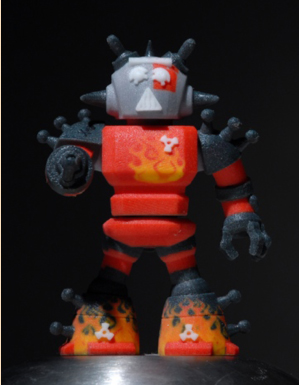
Leveraging their unique experience in video game development and the latest browser technologies in HTML5.0 and WebGL, Kodama has put the joy of play into creating in 3D. A featured application on the new Google Chrome Store, MyRobotNation.com provides you with the ability to go online, design and create a personalized robot collectible using a combination of 3D Web graphics and fast, affordable, and multicolor 3D printing.

Virtually anyone, not just experienced designers, can easily design their own personalized 3D robot creation that can then be printed as a high-quality figurine by Offload Studios, in vibrant color, on a Z Corp. 3D printer (ZPrinter). You can choose from more than 9 billion combinations of body shapes, limbs, colors, decals, and attachments. Video. Check out some photos of robots that have been created so far.

In his exclusive CNET article about the beta launch of MyRobotNation.com, Daniel Terdiman includes this quote from Stocker:

“At My Robot Nation, we believe that everyone is creative, and everyone can create – we all just need a fun and easy way to get started. Youtube, Facebook and Twitter show us how creative everyone can be digitally – we’re giving people an amazing new way to bring that creativity into the real world. Robots are only the beginning – the My Robot Nation platform is designed to be flexible and allow for the creation and customization of objects of any type. 3D printing is a revolution in creation and we want everyone to have access to it – now!”

ZPrinters are already being used to create animation characters for Pixar and personalized avatars for World of Warcraft gamers, expanding the creative possibilities for consumers and computer graphics professionals.

http://www.zcorp.com

Monday, October 31, 2011

Tricks, Treats, and 3D Printing for Halloween

This week’s guest blog is by Julie Reece, Z Corporation’s Director of Marketing Communications.

3D print of my face in honor of Halloween, because it’s just a bit creepy.
Every Halloween, we like to have a little fun here at Z Corp. There’s nothing like tricks, treats, and, yes, 3D printed models created on a Z Corp. ZPrinter to add some zest to Halloween.

I thought that multicolor, fully-textured, 3D printed Jack-O-Lanterns and a skull named Jane would do just the trick (pun intended).

Enjoy!


Fully-functional ZPrinted Halloween decoration

ZPrinted Jack-O-Lantern

ZPrinted pumpkin


ZPrinted Jane (it’s a long story)
http://www.zcorp.com

Wednesday, October 26, 2011

High School Students Have 'The Best Field Trip Ever!' Learning about 3D Design & 3D Printing at Z Corporation

Today's blog is from Scott Harmon, Z Corporation VP of Business Development.
With great fanfare we kicked off the EngineeringZONE program last week. Twenty-five students and three faculty members, led by June Krinsky Rudder from Revere High School, came to visit. After a brief introduction to the company, we split them into three groups. Each group moved through three different segments.

In the first segment, students got a tour of the manufacturing facility, led by our VP of Manufacturing, Matt Mandia. Z Corporation has been manufacturing 3D printers right here in Massachusetts for more than 10 years. We ship those printers all over the globe. Although labor costs are higher here, we get very talented assemblers who don’t just put things together, they actively participate in discussions about how we can design things so that manufacturing is less expensive and easier to do. The students saw our KanBan system for lean inventory control which also keeps costs down.
The students also got some hands on time with the printers and the prototypes themselves. Most of them had never seen a 3D printer or the output from a 3D printer. In our demo room, they saw all the printers in our line, as well as prototypes from just about every discipline we sell to. We had students who were interested in engineering, architecture, animation, digital media, medicine, etc. Fortunately, we have lots of different examples of prototypes and customers from all those different disciplines.
Students then learned why 3D printers are so popular with engineers, designers, architects, animators, etc. "Failing Faster to Succeed Sooner" is a message that resonated. Engineers, designers and architects, in particular, try to generate and test lots of ideas early in their design processes so they’re not fixing things later, when it’s more costly.

As a special treat, Z Corp. worked with MyRobotNation.com to let each student create their own robots during their visit. If you haven’t seen this application, you should. It’s really cool. Using a browser (Chrome and Firefox work best), you can actually design a robot and have it 3D printed. No CAD required. The application just went to public beta on the Google App Store. Best of all, in conjunction with My Robot Nation and Offload Studios, we’ll be providing each student with a 3D print of their robot.

More Photos

Videos

If you’re interested in bringing a class of students to Z Corp. as part of our EngineeringZONE program for the “best field trip ever!” (June’s words, not mine), please contact Olimpio DeMarco at odemarco@zcorp.com.

http://www.zcorp.com

Wednesday, October 19, 2011

Functional 3D Printed Clock

This week's blog is by John Luongo, Z Corporation Associate Engineer.


As a machinist and engineer; mechanical time pieces have always fascinated me. They are a perfect meld of both skill sets. I’ve been collecting them for ten plus years.

Sometime ago, I found a website where a gentleman from the U.K. shared his passion for wooden pendulum clocks. For a small fee he sent me a copy of the .iges files. I converted them to .stl and 3D printed the components half scale on a Z Corporation ZPrinter. I used zp150 composite resin for the build material and ZMax to finish them off.


I’ll have to admit that Generation 1 was a bear to assemble because of all the parts.


After I assembled the parts, I modified the models (Generation 2) by adding contrasting colors and subassemblies to the design and ZPrinted them in full color (orange and black - just in time for Halloween!).


Doing so reduced the part count from over seventy pieces to under twenty, and it works! I’ve learned so much from doing this. Stay tuned for Gen 3!
http://www.zcorp.com

Wednesday, October 12, 2011

It's Just Cool

Today's blog is from Scott Harmon, Z Corporation VP of Business Development.

OK. This week’s blog is not strictly MCAD related. Perhaps it falls more into the ‘It's just cool’ segment of our offering.

Obviously we’re always on the lookout for tools that help designers, engineers, and creative people in general to Create more™. This week we came across a really cool new tool that does just that. Autodesk releases 123D Sculpt for iPad. It’s a free app in the Apple App Store. It’s very cool, and really quite an amazing creative tool.

I have never seen a software application that is as easy to use for organic surface modeling, coloring and texturing as 123D. It’s really extraordinary. Did I mention it’s free? Autodesk has done an impressive job of utilizing the capabilities of the iPad (touch screen, multi-touch, etc.), and keeping the user experience really simple. There are only a handful of tools for modifying geometry, but when you get the hang of them, they are quite powerful.

Just as amazing as the ability to create compelling geometry is the ability to use color and even textures. The way textures work is especially clever. You essentially take texture maps from the library (or pictures you take yourself), place them over the shape, and then ‘rub’ the texture onto the surface. When you put all that together and add a creative mind you get content that is really compelling. You can check out some examples at http://123dsculpt.com/news/artist-profile-chris-kunzmann.html.

There is, sadly, one thing missing. You can do all kinds of 2D exports, but no 3D exports. No 3D exports for a 3D sculpting tool? Cynics might say that Autodesk just wants to protect their more expensive products. I’m not sure I agree. Exporting textures, meshes, etc. is not trivial. I suspect they wanted to push it out quickly to see what happens. They’ve already started adding premium content for a small fee. I suspect and hope we’ll see it added as an option in the future.

http://www.zcorp.com/  

Wednesday, October 5, 2011

Student Creates More with 3D Printing, Carbon Fiber and Fiberglass

Today's guest blog is by Scott Harmon, Z Corporation's VP of Business Development.
One of the most enjoyable things about working at Z Corp. is hearing about what students do with our technology. When you combine a 3D printer’s freedom to create with the unconstrained mind of a student, sometimes you get really amazing results.

One of my recent favorites comes from Red River College in Winnipeg, Canada. Serge Broeska, a student at Red River under the guidance of Leon Fainstein, recently got an article published in a prestigious industry journal called JEC Composites. The subject of their article: “A New Means of Making Dissolvable Mandrels and Patterns, Otherwise Known as ‘Rapid Prototype Composite Tooling’".

In essence, Serge and Prof. Fainstein used 3D printed parts from a Z Corp. 3D printer to make a pattern around which they applied carbon fiber and fiberglass. After the composites had cured, they simply washed the pattern out with water. In the project technical report, they documented huge (90%) savings in time and money to create a composite part vs. traditional tooling methods. In the article, they describe making a frame component, a handlebar, and a water bottle holder using this method.

Thanks to their creativity and hard work, they now have a handful of major composite manufacturers interested in further developing their research.

As cool as this particular application is, the cooler thing is that literally thousands of new students all over the world are using this technology every year. What will they create next?

http://www.zcorp.com/en/home.aspx