Wednesday, May 18, 2011

Designing and 3D Printing a Functional Kamen Rider CRD Helmet

Today’s guest post is by Russ Ogi, Chief Operating Officer of Z Corp Partner, RAPID Technology LLC.

Developing the Concept
Born and raised in Hawaii, I had the benefit of seeing both Western and Eastern superheroes. I grew up with American superheroes like Spiderman, Batman and Superman, but I was also exposed to Japanese superheroes like Kikaida, Inazuman and Kamen Rider.

The latter fall into the genre of Tokusatsu, Japanese live-action shows that involve superheroes. This genre spawned an estimated 3 - 4 billion dollar global industry that eventually made its way into all corners of the globe from Asia to Europe and the Americas. In the United States, the original Japanese shows eventually got watered down (due to US TV standards) into what most in the States know today as the Power Rangers.

So, what does a superhero geek do when he grows up and you give him access to a prototyping studio and some of the most talented artists in the industry? He makes superhero armor.

The idea behind the Kamen Rider CRD helmet was to create a more contemporary version of the original Kamen Rider V3 character from the 70's. The goal was to create a 1:1 scale wearable helmet based on this concept.

The Kamen Rider CRD Helmet
Sketching the Helmet Design

Concept pencil sketch for the "Rider CRD" design.


I worked with Calvin Lac, an Application Engineer here at RAPID Technology, on the design for the helmet. Calvin is an award-winning model maker and artist.

We tried to take original elements from the character and give it an edgier, more mature feel using antiquing techniques to make newly printed Z Corp 3D printed parts appear old. Calvin, an avid Gundam fan, tried to incorporate Gundam design elements as well.

I have a deep appreciation of Swiss surrealist H.R. Giger's work and wanted a bio-mechanical feel to the overall design. Some areas were to have organic, fluid looking curves, while other areas would have hard edges and well-defined lines. Above all, unlike some remakes, I wanted it to preserve the spirit of the character and pay homage to the original show, keeping long-time fans happy and hopefully winning some new ones.


Designing the Helmet in 3D CAD
Once we had the idea hammered out, we began designing in 3D with the CAD program Maya. At this stage, the helmet went through several changes and then was engineered for 3D printing.


Maya rendering showing computer-generated model half as a surface render and half as a wireframe.


"Rider CRD" 3/4 scale helmet prototype.


3D Printing the Helmet
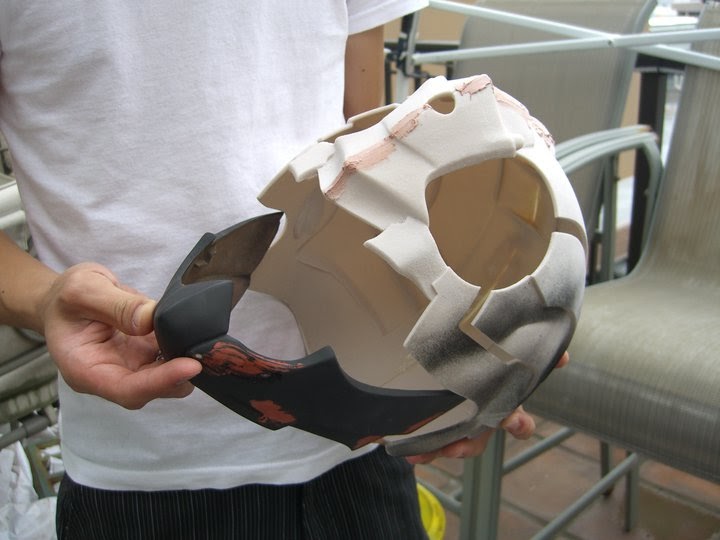
The 3D model was printed on the ZPrinter 450 in parts. We created the lower jaw separately to allow the helmet to be worn and retain a tight fit on the wearer's head. We finished the 3D printed helmet prototype with ZMax to provide extra strength to the helmet so it could be used as a true functional part in production work. Finally, we assembled the helmet and prepared the surface for gloss painting.


Rider Helmet prototype emerging from ZPrinter.


Test Fitting the Jaw

Fit adjustments for the faceplate.

Test fitting the jaw.


Painting the 3D Printed Helmet
We kept to the original color scheme of the character as much as possible. The original Kamen Rider V3 had a grey lower jaw. We opted for silver because we thought it would match the mechanical aspect of our design better. We also selected darker colors to give the character a more mature and contemporary feel. The helmet was painted in layers and sections.


Applying Bondo to the prototype.


First coat of primer and spot patching for the faceplate and jaw.


"Rider CRD" in his first coat of sanded-down primer.


Smoothing, joint patching for "Rider CRD."


Silver base coat laid down on "Rider CRD" helmet.


Metallic red overcoat going on the helmet.


Rider CRD in red metallic paint.


Casting the Resin Eyes
The Rider eyes were cast in resin. The masters were 3D printed and silicone molds were made. Then we mounted the resin eyes in the helmet.


Rider CRD... green eyes.


Adding Lights and Antenna
We added lights in the back of the eyes in order to give them a glowing effect. Finally the antennae were added to complete the look. Some of the smaller details were created in Z Corp’s ZBuilder Ultra plastic prototyping system and then painted.

Completed, functional 3D Printed Kamen Rider CRD Helmet: "Hmmm...something's missing..."


Next on the list, creating the entire suit?


Wednesday, May 11, 2011

The Role of 3D Printing and Scanning in the Community Development of Automobiles

Today's guest blog is by Scott Harmon, Z Corporation VP of Business Development.

I wanted to take this opportunity to share a very cool webcast about using 3D scanning and 3D printing in custom automotive design. The company is called Local Motors. There are a lot of companies out there that make short run replica cars, like Factory Five and ERA Replica Automobiles. These cars are very cool, and people buy thousands of them every year.

Local Motors' approach is very different. Instead making a replica, they’re using a community development model to create a new car. Their design community creates the concept for the car, and the Local Motors' team designs and fabricates it. In the detailed design and fabrication process, they determine how to integrate mass manufactured components and custom designed components. It’s a fascinating combination of re-engineering the as-built parts, and designing entirely new components. The combination is completely novel, and thanks to some smart engineers and some great tools, Local Motors can do it at a price that’s less than many stock cars.

Obviously 3D scanning and 3D printing are critical enabling technologies for these processes, and it’s no surprise that Local Motors uses ZScanning and ZPrinting to quickly and efficiently create an entirely new kind of car. The webcast goes into more detail about how they make cars and the tools they use.

Please let me know what you think of the webcast, if you have questions or want more information.

http://www.zcorp.com

Wednesday, May 4, 2011

3D Printed Trebuchet

This week’s blog is by Nick Stone, Z Corp. Project Leader, Mechanical Engineering, Research and Development.


When I was 15, I saw a PBS program on trebuchet’s and decided to build one in my backyard. Honestly, it was disappointing. My trebuchet threw a tennis ball about 10 feet and sliced a trench into our lawn.

I always wanted to give it another try, so I decided to 3D print a fully-functional trebuchet. I printed all of the parts on a ZPrinter 650. The axels ride in plastic bushing that are used in the ZPrinter 650 feeder assembly. The wheels do turn and are supposed to give you a little extra push. I found a video from the History Channel which provided some good advice on relative lengths, as well as a good way to hang the sling. The length of the string controls the release point as does the weight of the projectile. The heavier the projectile, the earlier the release, and thus the higher the angle. I’m not sure if this is typical of all trebuchets or unique to my sling.

Fully-functional trebuchet 3D printed on a ZPrinter 650

I’ve been threatening one of my fellow engineers, Guy, with my trebuchet since I started designing it. He finally had enough of my taunts and began ZPrinting his own trebuchet. His is about 20” tall and seems strong enough to launch a baseball a good distance. And so the arms race begins…

I decided that, because I had proven trebuchet technology, and since Guy was still perfecting his trebuchet, I’d be best served by improving my projectiles. I had been launching Delrin balls and drywall anchors, but decided to really strike fear into my enemies/co-workers. We have a low melt temp metal on hand, so I ZPrinted some molds and waxed them. I used a heat gun and hot plate to melt the metal and pour it into my molds.

ZPrinted mold for trebuchet’s metal projectile

A flying spiked metal ball is pretty scary (and dangerous, so here’s my disclaimer: Neither I nor Z Corp recommend you try this; if you do, you do it at your own risk and we cannot be held liable for any adverse results!). If Guy starts mobilizing his trebuchet, I might be forced to hold a demonstration near his cube. Until then, I think it’s enough that he knows I have the capability and am crazy enough to try it.

http://www.zcorp.com

Wednesday, April 27, 2011

Do you have 3D CAD?

Today's guest blog is from Scott Harmon, Z Corporation's Vice President of Business Development.

There is presently a great deal of interest in the notion of consumer 3D printers. The key question on everyone's mind seems to be when will we have one of these magical machines? However, as I have said before, 3D printers are pretty useless without 3D CAD. So to answer the question about when will 3D printers show up in the home, it might be pretty interesting to figure out how many people have and use 3D CAD.

I have personally heard estimates that range from 1 mm to 5 mm seats. Of course, these estimates are based primarily on professional CAD packages like Solidworks, CATIA, PTC, Invento, and the emerging Spaceclaim, etc. Most of the experts I have spoken to think that the approximate number of real, active seats of 3D CAD is around 1million. Not a small number, but there are 6 billion or so people on the planet. 1mm seats of 3D CAD would suggest that the penetration of CAD seats in the world is somewhat akin to the percentage of communists in Texas. Not zero, but not exactly ready for mass adoption.

Now obviously this is a bit misleading. There are a lot of ways to make 3D data that don't require real professional 3D CAD. There is a wide array of what could be referred to as 3D visualization tools available. These range from professional tools for animation and architecture like Maya, 3ds Max, FormZ, Mudbox to free tools like Blender and Google Sketch Up.

So yes, anyone with a computer and an Internet connection can acquire software that allows them to create 3D items. Some people clearly do. I suspect that most do not.

I know many of you are engineers and architects. So what do you think?  How many seats of engineering 3D CAD do you think there are in the world?  How many seats of other CAD do you think exist?

http://www.zcorp.com

Wednesday, April 20, 2011

3D Printing Critical to Symmons Industries’ Design Studio Live Virtual Studio

Today's guest post is from Julie Reece, Z Corporation Director of Marketing Communication.


Bathrooms matter in the design world. The room itself is a canvas for architects and interior designers to showcase their talents in a way that helps set a property apart from the pack. More fundamentally though, the bathroom “experience” is a critical factor in the discriminating consumer’s willingness to spend and select one property over another.

For these reasons, bathroom fittings – the faucet, showerhead, towel rack and even the doorknob – are too important to overlook when building or remodeling hotels, luxury condos and high-end homes. Property owners are increasingly demanding one-of-a-kind fittings to deliver a unique experience.

Symmons Industries, 70-year-old manufacturer of commercial and residential plumbing products, has long served this market with custom design and manufacturing services. The company broke new ground with the launch of a first-of-its-kind virtual design studio for architects, designers and property owners, called Design Studio Live.

Design Studio Live is a Web-based program that allows users to create their own products and receive color 3D physical concepts of their designs within four days, metal prototypes in approximately 15 days, and delivered product for their property in as little as 16 weeks. With the help of this innovative new tool, architects and designers can create unique ideas that translate into exclusive fittings for their projects right from their desks. Users can begin by digitally paging through a virtual catalog of ready-made designs, dragging them to a virtual light box, and modifying them with Google SketchUp™, Adobe® Photoshop®, SolidWorks®, or any other 3D CAD program.

Eric Spear, Symmons’ director of custom services said, “Symmons is the only manufacturer offering fully customized plumbing fittings, and Design Studio Live makes it easier than ever for a designer to complete their bath design with products tailored for each project. We’ve built a process in which we can execute a custom design in the time it takes to flip through a catalog.”

Symmons design consultants are available for program guidance or design advice. However, users are encouraged to experiment as much as they’d like because the tool is designed to encourage creativity. The Design Studio program is also a tool for tracking and managing the progress of a project.

Challenge: fast-turnaround concept prototypes

Critical to the Design Studio Live formula is the ability to quickly and affordably churn out physical 3D models at high volumes. With this demand, handcrafting models was out of the question due to the time and labor involved. For Symmons, a 3D printer was the answer to creating a great custom service for its customers.

Long before Design Studio Live was conceived, Symmons owned a Dimension® 3D printer. Design consultants only used the printer intermittently because it took too long to get a prototype. Spear said that a single faucet took 15 hours to print.

Solution: ‘ZPrinting’

A local Z Corp. reseller told Symmons it could fix the turnaround problem with a printer from Z Corp. Symmons designers said, “Prove it.”

They did just that; instead of taking 15 hours to print a single faucet, Z Corp.’s 3D printer printed 12 models in 3.5 hours at half the price of the single model produced by the Dimension machine. Put another way, the ZPrinter could produce 48 prototypes in the time it took the Dimension machine to print one. Convinced, Symmons purchased the ZPrinter to create prototypes on demand, giving them the final piece of the puzzle they required to realize the vision of Design Studio Live.

Results: a thriving Design Studio Live

The ZPrinter and its 3D printed prototypes are turning out to be the driving force behind Design Studio Live.

Spear said, “The design process itself is exciting, but there comes a point when it’s really helpful to see a tangible, physical example of it. By ZPrinting 3D models, designers can stop looking at their screens and see what the part really looks like in context and feels like in their hands.”

The Z Corp. 3D printed prototypes also strengthen the relationship between an architect and a property owner. Spear said, “Architects can slide a set of ZPrints across the table – perhaps faucets of different sizes and shapes – along with a red pencil. The property owner gets a rare opportunity to handle the models and mark them up. The architect comes back with revised models a couple of days later, and the owner is blown away by the architect’s responsiveness.”

3D printing has also helped enable Symmons, known for the superior workmanship of their internal plumbing parts, to show their design capabilities. For example, the Mandarin Oriental, New York wanted a distinctive look and feel for its bathrooms, and their design firm turned to Symmons to help create the details of the design. The bath design called for a shower system that incorporated fittings with a ceiling-mount drench showerhead and a Roman tub filler that was both stylish and simple to operate. Symmons developed custom concepts for its client with an elegantly simple, single control for on/off, hot/cold operation, a feature that helped to overcome the language barrier many international guests experience. ZPrints helped Symmons communicate a range of options to the client, which enabled the team to quickly close on a final solution. It was the same story at a Miami hotel where ZPrints helped Symmons refine the design of a vertical showerhead surrounded by chandeliers. Other satisfied Symmons clients include the Wynn Resorts, Four Seasons and The Ritz-Carlton, to name a few.

The Z Corp. 3D printer was printing at full tilt five days a week, 20 models a run, according to Spears. In the first four months of use, Symmons produced 4,000 prototypes for a wide range of applications. Most were for client projects, but models also went to tradeshows, “lunch and learn” seminars with designers and architects, and to Symmons industrial designers. “You can push the print button during morning coffee break and be passing around prototypes at lunch. Z Corporation is enabling the kind of speed and part quality that is indispensable for Design Studio Live and all of our design work here,” said Spear.

The ZPrinter and its unique color capabilities have also produced other surprising benefits. They help Symmons stretch design concepts and prototypes beyond conventional stainless steel, using color to accurately represent the popular finish of Onyx. Color prototypes also make great promotional handouts – for instance, a brightly colored faucet model with an architect’s name on it. Symmons even brings its ZPrinter to tradeshows and prints nonstop, making its booth a popular stop for designers and architects witnessing the possibilities of both Symmons designs and instant prototypes.

Whether at tradeshows or in Design Studio Live, 3D color printing enhances Symmons’ business and brand by helping the company focus as much on the aesthetic considerations as the internals. The company is now able to prove that it can make the most beautiful “facades” – or better yet, help customers make them.

Spear said, “It’s a great experience to be the first in market to do this. Our unique ability to host a full-service virtual design studio with 3D printing capabilities, and do it so painlessly, is a real differentiator and a powerful one that keeps us in top of mind to our clients. Z Corporation’s unique speed, color and affordability make this possible.”
http://www.zcorp.com

Wednesday, April 13, 2011

3D Printing Helps Cisco Uphold Scandinavian Design Tradition

Today's guest post is from Julie Reece, Z Corporation Director of Marketing Communications.

Designers at the Cisco Consumer Business Group combine time-honored aesthetic principles with 3D printing technology to produce some of the world’s most elegant consumer electronic equipment.

Devices like wireless routers, the media hub, and the wireless home audio system create what the Cisco calls the “connected life,” a life that’s more personal, more social, and more visual. Constant network connectivity is a given, and the focus is on the content – the music, video, Web pages and work materials coursing through the home, office or classroom.

As these devices further infiltrate the home, networking gear becomes more central to our lives, moving from the “computer room” to the living space. Like a stainless steel refrigerator, electronics must be aesthetically pleasing with sleeker, less boxy lines, while increasing connectivity, reliability, and intuitive operation. Making functional objects both simple and beautiful is the challenge Cisco engineers face every day.

Challenge: upholding traditional design standards in the fast-growing consumer electronics world

Since design excellence is paramount for Cisco, the company established a European Design Centre in Copenhagen, Denmark. Here the company continues the venerable tradition of Scandinavian design – functional, minimal, and affordable – without comprising design aesthetics.


Scandinavian design tradition requires the engineer to hold a prototype of his or her creation in their hands, sense the proportions, heed what the object has to tell them and ensure that the form ultimately follows the function. The artisan then modifies the design, creates another prototype, and examines the new design just like the first.

The problem is that traditional handcrafted prototypes are time-consuming and expensive to create. Most automated rapid prototyping technologies are just as costly and must be outsourced, adding time and inconvenience to the process. And though many designers rely on 2D screen images alone, they are simply insufficient to create the quality that Cisco demands. The challenge, then, is upholding the highest aesthetic standards while meeting deadlines in the highly competitive consumer electronics business, where time to market is critical.

Strategy: Investing in 3D printing technology from Z Corporation

Z Corporation’s 3D printing technology helps Cisco quickly and inexpensively create the physical models, or prototypes, it needs. 3D printing gave Cisco a way to apply its exacting design standards in a way that keeps the development cycle humming, ensuring that products get to market on schedule. ZPrinting pumps out prototypes in hours instead of weeks and for one-fifth the cost.

Eskild Hansen, Head of Cisco’s European Design Centre said, “Proportions and ergonomics are paramount, yet too many designers rely on computer screens alone as their design medium. For our strategic design approach, we depend on physical prototypes and the ZPrinter® for each design review, both locally and globally in concert with our design partners in the United States. ZPrinting is an easy and effective way to conduct a productive global design review.”

Results: lots of models for productive design reviews

Cisco uses their ZPrinter to create 10 models per week, on average, for design review. Models are printed directly from SolidWorks® 3D CAD files submitted by Cisco designers around the world.

Designers pass around the resulting models, mark them up with pencil, revise designs in SolidWorks software, print out new prototypes, and repeat the cycle as necessary. The hands-on step is an absolute must, according to Hansen, who selected Z Corporation’s technology because of confidence in the brand and his experience using it in other settings. He said, “We get prototypes quickly, we refine them quickly, we create new ones, and we derive our elite designs. It’s inspiring to see what my team can do with what the world has always received as a basic black box. Designs like these don’t just emerge from a computer screen. Because design is very important, 3D printing is an important element of our product strategy.”

http://www.zcorp.com

Wednesday, April 6, 2011

Cutting-Edge 3D Printing, 3D Scanning and 3D Software Used in Design of Local Motors' Rally Fighter

I missed the opportunity to attend SolidWorks World 2011 a few months back, but those that did go came back excited about what they saw. One story that intrigued me enough to investigate further is that of Local Motors. I didn’t know anything about this company. As I searched the internet it became obvious that this company is different. Different product. Different business model. So different, in fact, that it would be difficult to explain accurately in a short blog posting. I encourage you to visit the links below and do your own search.

There is a definite “cool” factor being involved in cutting edge, emerging technologies like 3D printing. 3D printers, 3D scanners and 3D software are creativity tools. They help people be more creative, more efficiently. I’m not a hardcore car buff but I know a nice looking car when I see one, and my first thought when I saw Local Motors’ Rally Fighter was “Now That’s Cool.” As I dug further, I started to realize how this company was benefitting from using a community approach to design and technical challenges, and was also benefitting from cutting-edge creativity tools and design software.

At SolidWorks World 2011, Jon Hirschtick introduced Mike Pisani, Senior Vehicle Engineer and Head Builder Trainer for Local Motors, who described the process for redesigning standard parts to fit their specific needs. The process includes using a handheld ZScanner to accurately convert the part into 3D data, SolidWorks to modify that data and a Z Corp ZPrinter to prototype and verify those changes.

I mentioned in a previous blog how one of my favorite end uses for ZPrinted parts was the Pixar Zeotrope, but I think the Rally Fighter has moved up on my list of very cool end users.

You can hear Mike Pisani from Local Motors talk about how he uses this technology in a live Webcast on April 27 at 2 PM EDT: http://lnkd.in/5v2V7h.
 
http://www.zcorp.com