Wednesday, December 29, 2010

Color 3D Printing Improves Communication

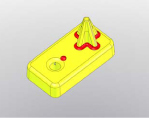
A number of years back I needed to make a simple change to a simple part. The part was injection molded which meant that a change to the part required a change to the tool. Typically, I would send the new STL file to the mold maker and explain the changes in an e-mail. They would plug the STL file into their software, analyze the changes and provide a quote for the modifications. In this particular case I highlighted the changes in red color, printed a model and handed it to the mold maker. Even simple changes to an injection molded part can require complicated tooling changes depending on where cooling lines, ejector pins, rings, and gates are located. Having the actual part with highlighted changes helped the tool maker quickly understand what it would take to successfully modify the tool. A picture of this part, used in our 3D Printers, is shown below.

I recently visited a Z Corp. customer who uses a ZPrinter®650 in a similar way. He frequently uses multiple colors to identify different fabrication processes required to complete a part. His parts are complicated shapes from exotic materials. For example, he will highlight the first process with one color, a second process with another color and might add a third or fourth color to show other areas of interest on the part. Because the parts are so complicated and expensive, poor communication can lead to costly mistakes. His main purpose for creating color models is to improve communication throughout the design and fabrication process.

Wednesday, December 22, 2010

Memorable ZPrinted Holiday Ornaments

Every year around this time Z Corporation holds its annual holiday party. It is usually memorable in many ways but one thing that stands out for me is the Z Corp. holiday ornament. David Russell is one of our most senior engineers and for years now he has taken on the task of designing and printing one for every employee. Below is the chronology in pictures. It is interesting to note that over time color was introduced and features became smaller and more delicate as both the hardware and materials technology improved. I want to take this opportunity to thank Dave and I hope this tradition continues for many more years.

2001

2002

2003

2004

2005

2006

2007

2008

2009

2010
Happy Holidays!

http://www.zcorp.com

Wednesday, December 15, 2010

Consumer 3D Printing? Part II

Thanks for the great responses to last week's blog posting: Consumer 3D Printing? I agree with many of the comments. One in particular I agree with is that open source FDM 3D printers are not for the average consumer.

Open source goes a long way toward lowering cost, increasing awareness, and advancing 3D printing technologies. These are all important in order for 3D printing to become a consumer activity.
In my opinion though, in order to break through to this market it must also be fast, have simplicity and elegance. I think of the average person coming home from work (not a technical person) and finding that broken knob on the stove. What would it take for 3D printing to be the preferred method of replacing the knob?

At the very least it would have to be as easy as going to the manufacturers website, picking out the replacement knob, placing an order with a credit card and waiting a few days for the “original” knob to arrive in the mail. 10 to 15 minutes of time online, 2 days waiting, and no technical experience necessary. Open source – and all commercial 3D printers have a ways to go before they can compete with that.

One of the reasons it is difficult to imagine consumer 3D printing is that most everything in the home, office, or car has been mass-produced. That means a tool most likely exists that can turn out replacement parts by the thousands at a very low cost. 3D printing is ideally suited for printing “snowflakes”. The theory is that no two snowflakes are the same. So, if you wanted to produce just a single piece of a one of a kind object would you produce a steel tool and injection mold it?

This is the sweet spot for 3D printing and why it is used for concept models, early stage design verification, architecture, art, low volume prototype parts, etc… Yes, consumers would most likely use a 3D printer to make one or two of any particular part but that part most likely already exists somewhere by the thousands or even millions.

Wednesday, December 8, 2010

Consumer 3D Printing?

A question I get a lot lately is what do you think about consumer 3D printing ? The premise is that someday 3D printers will be as prevalent in people's homes as color inkjet printers are today. Is this far-fetched? If not, how far off is it? And, most importantly, what needs to happen in order for it to become a reality?

The answer isn’t simple. In fact, if there are a dozen or more issues that need to be resolved, the solution for each issue will depend on the solution for the other variables. The first thing you might consider is to lower the cost of a 3D printer to a point where the average consumer could afford one. It might seem obvious that if millions of units are sold every year the cost would come down and be affordable to the consumer. However, if there was a stack of 3D printers on the street corner free for the taking, how many people would take one home with them? And remember, we are talking average consumer, not average design engineer. If they all found homes, what would people print with them? There is no doubt that 3D printers add tremendous value to a commercial enterprise and that color inkjet printers add significant value to most homeowners. But the applications are quite different. The concept that a homeowner would need a 3D printer is based on the idea that they could print final parts at a reasonable cost.

For comparison I’ll use a single part, a control knob for a residential gas stove top. The stove manufacturer would most likely design the knob, prototype it to make sure it looks, feels, and functions correctly. They might even print a tool and cast a limited number of urethane, or metal parts for further evaluation. Once they are comfortable with the design they would order tooling and injection mold the knob using a high temperature flame rated material. Let’s say the homeowner somehow lost the knob for their gas stove top. The first thought would be to use a 3D printer to make a new one. To do so, the homeowner would either have to find or create the 3D data before they could print the part. They would need some type of design software to design a new one. Or maybe they could scan one of the remaining knobs and import the data. But, let’s say there was a database of parts free to download over the internet.

The next step would be to make sure the material properties were adequate for the knob. We know from the application that the material should be high temperature and have a high flame rating – possibly V0. Even if this material existed, the homeowner would have to have it on hand or locate and purchase some. The next part they want to print might require a completely different material. Keeping a stack of document paper and a stack of glossy photo paper isn’t all that difficult, but having all the different materials that might be needed for “real parts” off a 3D printer would be next to impossible for a homeowner. Ordering the right material as it is needed might be the only option. In the time it takes to locate, purchase, setup, and print the knob, would it be easier, cheaper, and faster to order the actual knob from a local stove repair shop?

So, is the idea far-fetched? How far off is it? Weigh in and let me know what you think!

http://www.zcorp.com

Wednesday, December 1, 2010

Six Steps to Assess the True Cost of a 3D Printing System

There’s been a lot of hype over the past year about low-cost 3D printers. All of the rapid prototyping (additive manufacturing) companies have either introduced low-priced systems to the market or lowered the price of existing systems and promote how they are making the technology more accessible to designers, engineers and even the hobbyist. Editors, industry analysts and even the New York Times have jumped on this trend which seems to be the focus of nearly every article and report.

But what is a low-cost 3D printer? When people talk about low cost, they seem to refer only to the purchase price of the 3D printer. Sometimes machines that are billed as low cost are actually much more expensive than most other machines when all variable costs are factored into the equation. We’ve had customers tell us that they purchased another system because of the low initial purchase price of the printer itself, only to quickly discover that they couldn’t afford to keep the system operating. It became an expensive paper weight.

So, how can you cut through the hype and determine the real cost of a 3D printer? Here are six easy steps.

First, let me provide a disclaimer that I’m only referencing industrial- or professional-quality 3D printers. Industry experts seem to universally agree that open source systems that have been receiving quite a bit of publicity recently are not suitable for professional use from a quality, accuracy, throughput or speed standpoint.

1. Yes, affordability starts with a low-priced machine. But look beyond the price of the machine itself. Check to see if the system requires expensive lasers, complex thermal controls or special facility requirements. All of these items can add thousands of dollars onto the price of a machine.

2. How expensive is the build material? Find out how much build material is included in the purchase price of the system. Be sure to base this cost on volume rather than weight (i.e.; how many prototypes will that amount produce?). Then learn the on-going replacement cost of the material.

3. What about waste? Is all of the unused build material from a build completely recycled for future builds and therefore unwasted? If not, make sure you factor the cost of the wasted material into your cost calculator. And, does the system require you to build supports? Some systems require you to build supports, others don’t. Building supports requires expensive build material that can really add up over time, so be sure you factor this ongoing cost into your estimate.

4. What about the cost of post-processing? All prototyping systems require some sort of post-processing. Check to see if you must purchase additional equipment, chemicals, ventilation and special hazardous waste handling and disposal in order to post-process parts. Compare those systems with systems that provide you with the low-cost option to cure parts with tap water and Epsom salt.

5. Assess maintenance costs. Some systems use standard, off-the-shelf inkjet printing technology and a modular design in order to make component replacement quick, easy and cost efficient.

6. Considering all of these variable costs, estimate the total expense per finished model.

Example:
Total cost for Z Corp.’s finished ZPrinted models runs about $2 - $3 USD per cubic in ($0.12-$0.18 USD per cubic cm). An 8.75 cubic in (143 cubic cm) model like the one below costs about $22 USD to produce.

If low-cost 3D printing is important to you, “Buyer beware.”

http://www.zcorp.com  

Wednesday, November 24, 2010

Is 3D Scanning Entering the Consumer Market?

Guest post by Scott Harmon, Z Corp. VP Business Development.

One of Z Corporation’s strengths is that the our technology is based on highly reliable, mass manufactured consumer technology, specifically HP print heads. You would have to be hiding under a rock not to notice that a number of 3D technologies are entering the consumer space. 3D TV’s and movie screens are wide spread, and much has been made of 3D printing kits. But what about 3D scanning? It appears that the time has come.

Many of you have probably heard of Microsoft’s new Kinect. Kinect is a game controller for Xbox, or perhaps the replacement for a game controller. Fundamentally, Kinect can see what you are doing, and it uses your body motion as the interface to games. Technically, Kinect consists of an infrared chip that projects images on a surface and reads them back to determine 3D shape. It also has a camera for capturing color. If you put these together you get a device that can capture color 3D data - for just $150 (USD).

Clearly the data resolution and quality are not going to be anything near what you get with a professional-quality 3D scanner, but at $150, there are going to be a lot more people able to create 3D data very soon. The first hackers have already adapted the Kinect to work on a regular computer and generate 3D data. You can see an example of this at http://www.youtube.com/user/okreylos#p/u/5/7QrnwoO1-8A.

If you know someone who’s creating 3D data using the Kinect, let us know; we’d be happy to make a full color 3D ZPrinted model from the Kinnect data!

http://www.zcorp.com

Wednesday, November 17, 2010

Physical and Digital Prototyping Belong Together

Guest post by Julie Reece, Z Corp.'s Director of Marketing Communications.

Makers of 3D CAD software for digital prototyping sometimes claim that their systems eliminate the need for physical prototypes. However, physical and digital prototyping complement one another. Both should become an integral part of your product-development processes.

In fact, physical prototypes are much in use today because they are essential to creating great designs. Thanks to the speed of 3D printing systems, innovative product developers use more physical prototypes than they did when each prototype was hand crafted, and combine them with digital prototypes to accelerate design.

Digital prototyping tools allow detailed 3D models to be conceived and changed quickly. But computer graphics is no substitute for reality. When combined with additive manufacturing technologies, physical prototypes can be made from digital models quickly and with much less labor than was traditionally required.

Deciding when and how to use physical prototypes in addition to digital prototypes requires knowledge of both digital and physical prototyping methods. Engineering executives and managers need not become additive manufacturing experts. However, they or their designated staff members should familiarize themselves with the various physical prototyping system capabilities, materials, costs, building speeds, and accuracies. With this information, managers will have rational bases for deciding if and when making a physical prototype is more cost effective than analyzing or simulating product behavior with digital prototypes.

Whether you are evaluating physical prototyping technologies in order to purchase a system for your company or employ a service, keep these points in mind:

1. Faster systems with higher throughput to produce multiple models simultaneously are desirable for iterative, conceptual prototypes or visual prototypes that support detailed design, manufacturing engineering, or marketing.

2. If you plan to make many prototypes, low material costs may be more important than buying a low-priced system.

3. Color systems eliminate the need for painting and finishing.

4. Strong but flexible materials may be needed for evaluating snap fits.

5. Some technologies are well suited to making patterns for metal castings while others are not.

6. Higher-strength materials may be necessary for physical testing.

7. Systems with fine surface finish may be required for working prototypes or final advertising shots, but can take longer to produce.

Companies that make wise choices about both digital and physical prototyping technologies will have competitive advantages compared with companies that don’t. The effective combination of both CAD and engineering software with 3D printing and rapid prototyping assures that your company will deliver products that are desirable, affordable, reliable, and safe.

Excerpt of a white paper entitled, “Physical and Digital Prototyping Belong Together,” by L. Stephen Wolfe, P.E.  Read the full white paper.

L. Stephen Wolfe, P.E. is a professional mechanical engineer based in San Diego, California. For more than 20 years, he published the newsletters Computer Aided Design Report, Rapid Prototyping Report, and Product Data Management Report as well as books on these topics. These publications filled the role of Consumer Reports for engineers seeking objective information about product-development technologies. He currently assists buyers of CAD/CAM, CAE, PDM, and rapid prototyping systems with defining their requirements, conducting independent research, identifying and negotiating with suppliers, and implementing new methods efficiently. www.cadcampub.com 

http://www.zcorp.com